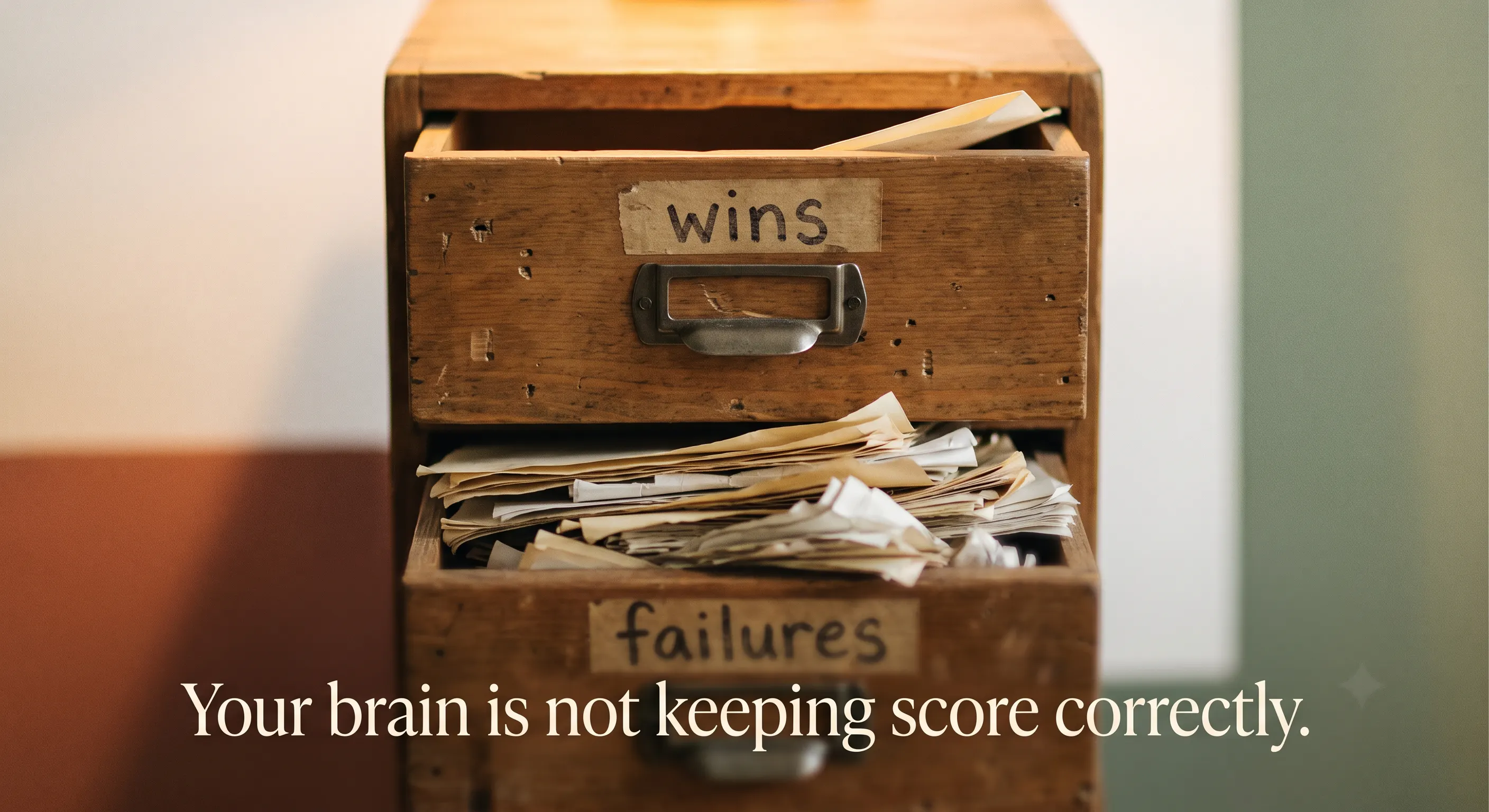

You had a solid week. You solved something difficult, stayed steady through a conversation that would have derailed you six months ago, helped someone through something hard. By Sunday you mostly remember the thing you didn’t finish and the general sense that you haven’t done enough.
This is not necessarily pessimism. Attention and memory do not give equal weight to every part of a week.
Negative information can carry more weight
Your week held both progress and problems. But the problems feel more real than the wins, which is its own kind of unfair — the same brain doing the hard work is also the one systematically undervaluing it.
Psychologists use the term negativity bias for several ways negative events or information can have a stronger effect than comparable positive material. A broad 2001 review found this pattern across domains including attention, learning, memory, relationships, and judgments. Later researchers have also warned against treating it as one simple, universal brain mechanism.
Evolutionary explanations are plausible, but they do not mean every person remembers every threat better than every success. Age, mental state, context, and the kind of memory task can change the pattern.
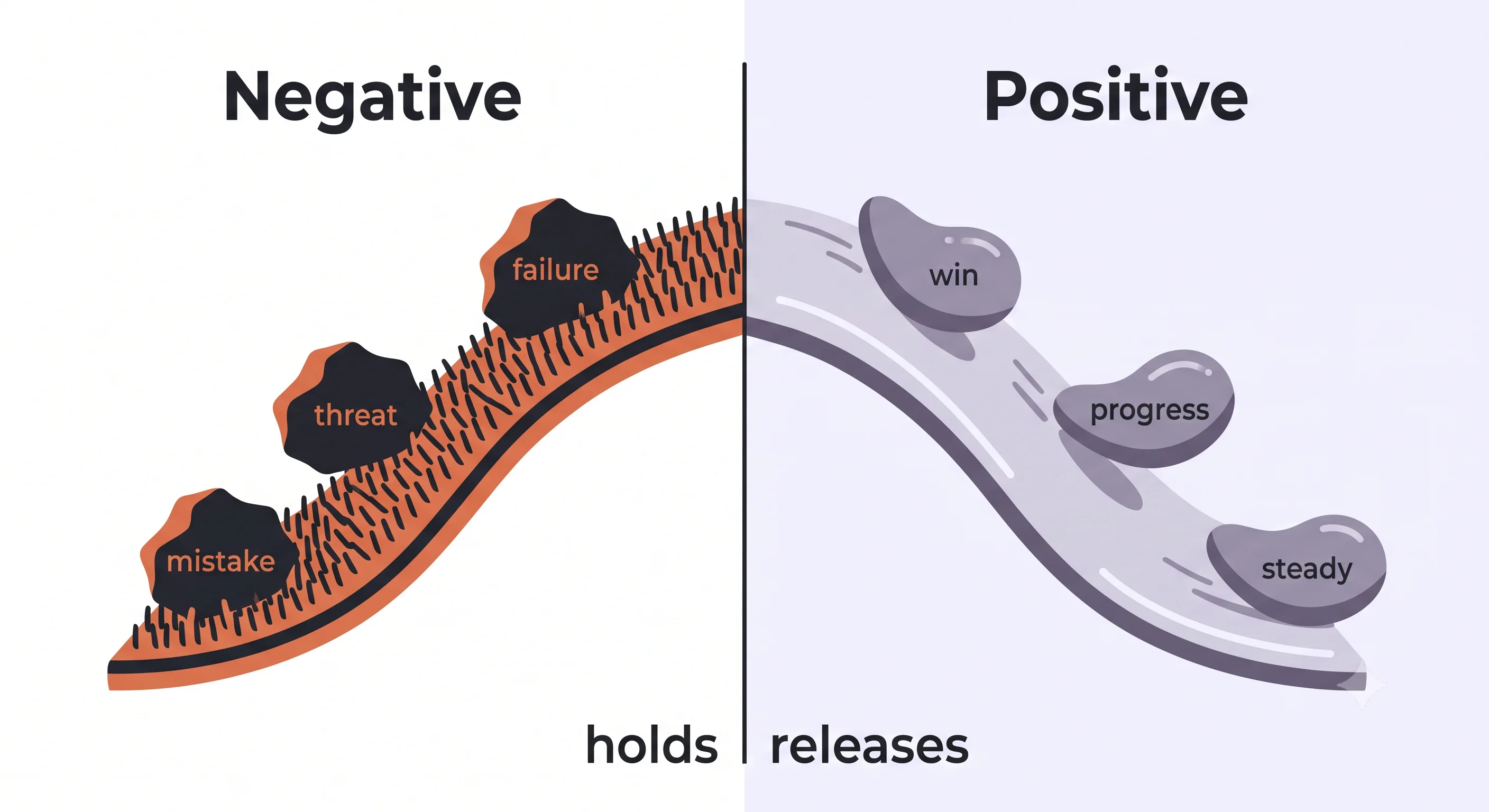
One unfinished task can dominate the memory of a week that also contained progress.
The practical problem is not that the mind follows a fixed filing ratio. It is that quiet progress is often less salient and less retrievable than the mistake still demanding attention.
◆ What's really going on
The problem is an incomplete review: your progress can be harder to retrieve than the failure that still feels unfinished.
Build a record the brain can’t erase
A written record is a practical workaround, not a neurological cure. It gives your future self evidence that does not depend on recalling the whole week accurately in a tired moment.
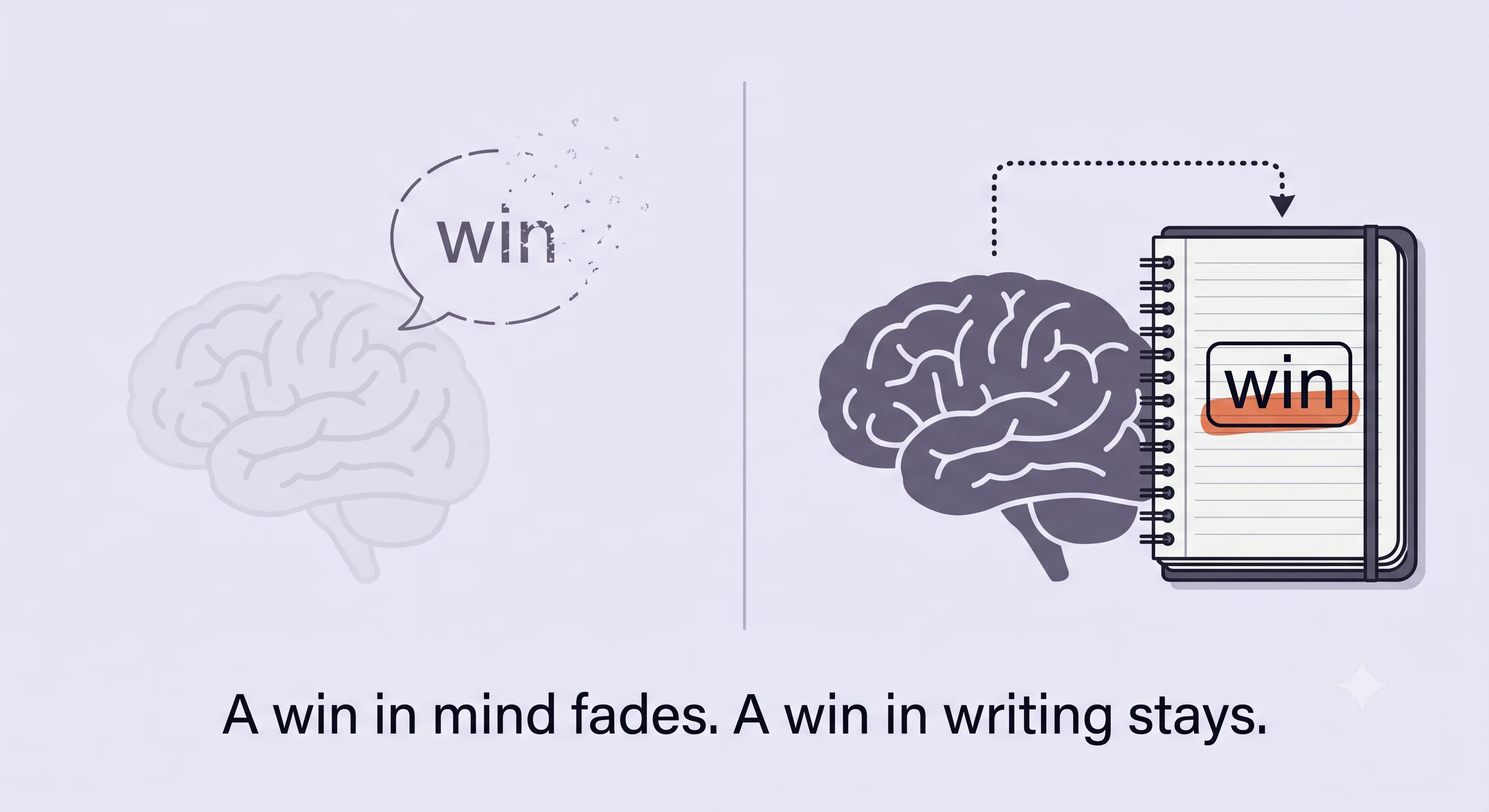
Write the win in concrete, observable language.
Vague entries — “did my best,” “had a better day” — leave faint traces. Concrete ones don’t: “I paused before replying to that email,” “I said no to the second ask,” “I finished the brief even though I didn’t want to start it.” Observable language is what makes a win retrievable. If you use Keiko, the Microwin flow asks for the win in your own words, with a win kind category — the structure pushes toward the specificity that actually encodes.
Name what the win gave you.
After logging the win, name what it produced: relief, confidence, momentum, calm, connection, pride. Keiko’s Moment log captures this as a second layer, making the entry more informative than a completed item on a to-do list.
Read your record at the week's lowest point.
When you are tired or discouraged and tempted to call the week a failure, read back what actually happened. Treat the record as a data check, not a pep talk. It cannot force a positive interpretation, but it can challenge an incomplete one.
You stop building your identity from what the brain skips
When you capture wins consistently, your self-narrative becomes more accurate. Not more positive. More true.
The gap between what happened and what you remembered starts to close — not because you have better weeks, but because the record holds what your brain would otherwise release. You stop treating quiet competence as evidence of mediocrity. Staying steady, holding something hard, setting a boundary: these are exactly the wins the negativity bias targets hardest, because they leave the lightest natural evidence. A record makes them visible.
The long-term shift is in what you can see when you look back. Instead of a blur of what didn’t happen, you have a retrievable account of who you were under pressure and how you kept going. That account is what actual self-trust is built from — not a belief about yourself, but a documented record you can verify.
Sources and limits
- Baumeister RF et al. (2001), Bad is stronger than good.
- Norris CJ (2021), How negative is negative information?.
- Hilgard J et al. (2018), Rethinking the negativity bias.
Negativity bias is a family of observed effects, not proof that the brain literally deletes positive memories. Keeping a record helps retrieval; it is not a clinical intervention.
Download KeikoAI.
Keep a record of progress that is easy to revisit — available on iOS and Android.
Try KeikoAI freePrivate by design · No streak pressure
Follow us to see what's new