

You’ve been told to “identify what you’re feeling” so many times it started sounding like advice you’re supposed to agree with but can’t actually use. You say you’re anxious and you still feel anxious. Nothing shifted. So you start wondering if the whole practice is just a wellness slogan dressed up as a technique.
The disconnect is real. But the practice is not wrong. What’s missing is the mechanism.
What affect-labeling studies actually found
From the outside, you’re just carrying a feeling. From the inside, it’s shapeless and large enough to color the whole day. And most of us were taught that naming a feeling is passive: a description, not an intervention.
Researchers call the act of putting feelings into words affect labeling. In a 2007 fMRI study, participants who labeled the emotion shown in negative images had lower amygdala activity than participants completing other encoding tasks. Activity increased in the right ventrolateral prefrontal cortex, and the authors proposed a pathway connecting those responses. A later study found overlapping brain activity and lower self-reported distress during affect labeling and reappraisal.
Those studies support a modest claim: labeling can change emotional processing under laboratory conditions. They do not show that finding the perfect word will always calm someone, resolve the cause of a feeling, or replace appropriate support.
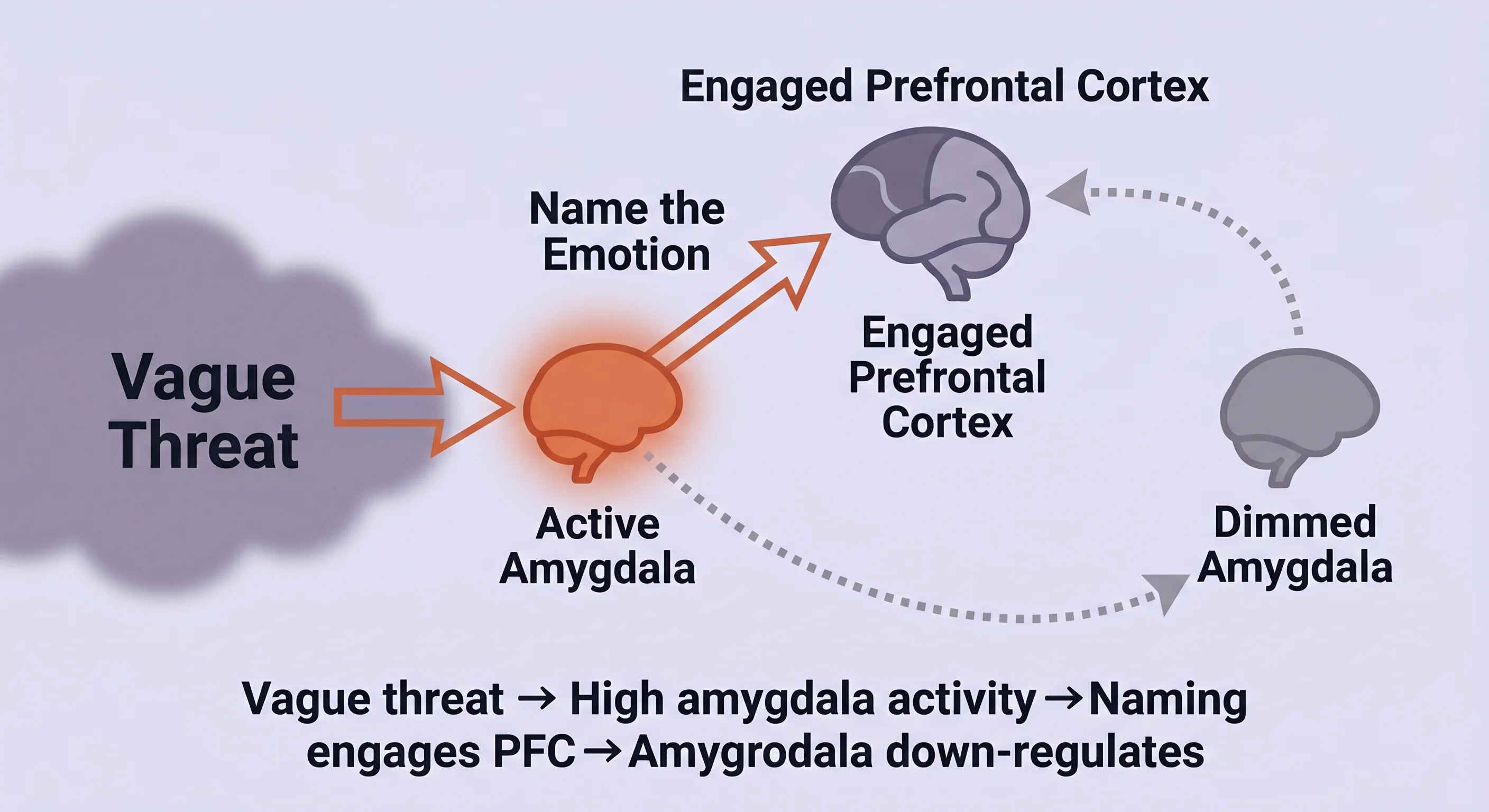
The threat doesn’t disappear. But it narrows. A vague, ambient feeling with no name can expand indefinitely. A named feeling has edges.
Imprecision can still be a practical problem. Calling everything “stressed,” “fine,” or “off” gives you little information about what kind of response might help.
The threat doesn’t disappear. But it narrows. A vague, ambient feeling with no name can expand indefinitely. A named feeling has edges.
Name the state precisely enough to give it edges
Precision matters here in a way that “name your feelings” advice never specifies. “Stressed” does not narrow the signal enough. “Resentful” does. “Overwhelmed” is wide. “Overwhelmed and afraid I’m falling behind” has a shape.
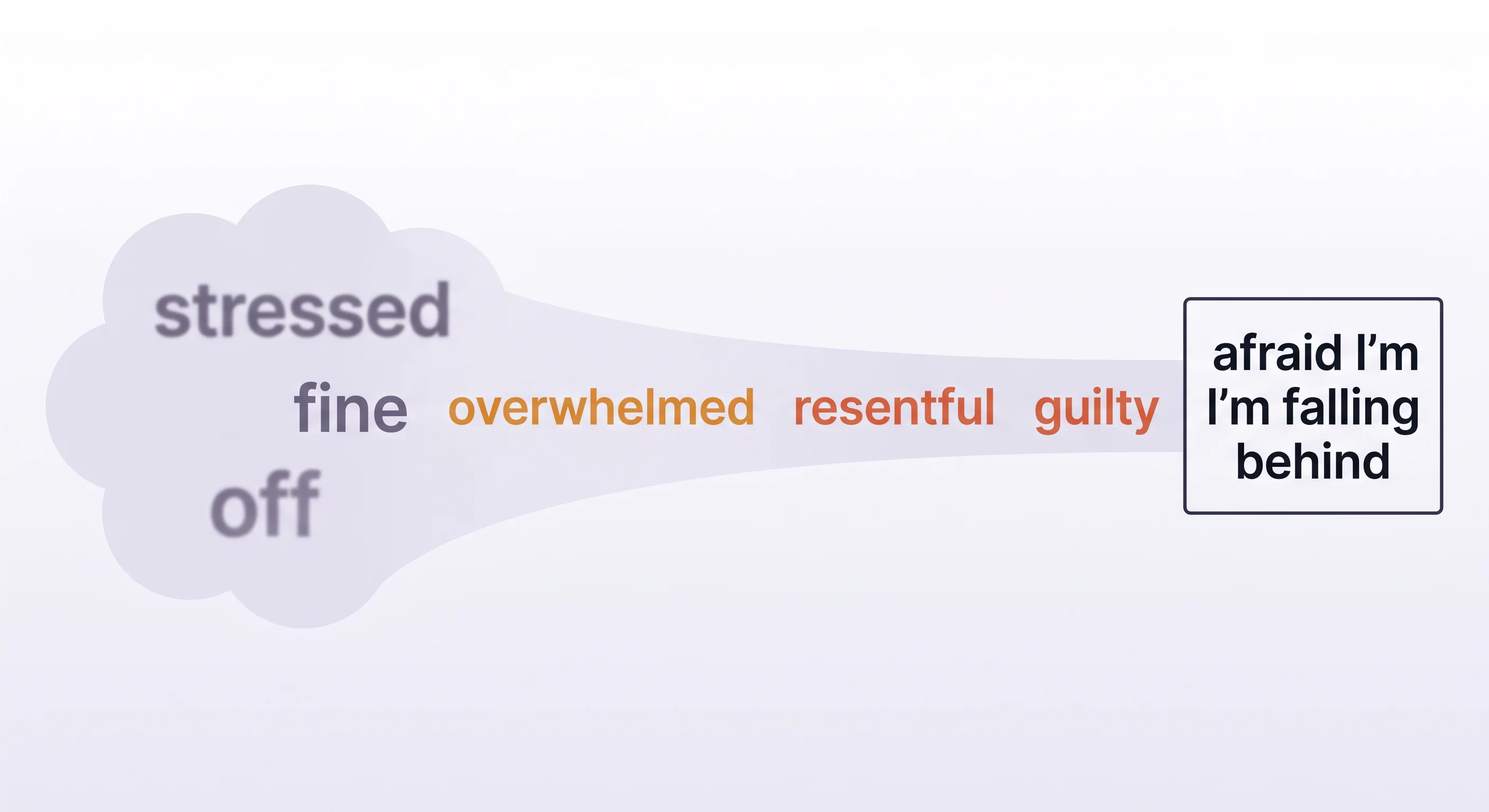
Reach one layer beneath the first word.
Primary labels such as stressed, tired, or sad may be accurate but broad. Try the layer beneath: Am I actually resentful? Guilty? Uncertain? Numb? Each points toward a different need. Keiko’s Mood flow can help you explore that second layer without claiming that one label is medically correct.
Split valence and energy.
These are two different signals. Low energy plus a positive feeling needs something different than low energy plus a negative one. Keiko’s mood layers capture both automatically. But even without an app, consciously separating “how positive or negative is this” from “how depleted or activated am I” gives you more usable information than a single label.
Externalize it — write or say it, don't just think it.
Write it, say it aloud, or type it into a check-in if that makes the label easier to examine. The studies below tested verbal labels in structured tasks; they do not establish that writing is always more effective than thinking the word silently.
◆ Precision makes the next choice easier
A more specific label may not remove the feeling, but it can give you a clearer question to work with.
The feelings stop being weather you’re caught in
When naming becomes a practiced habit, your relationship to your own emotional states changes — not because the feelings get less real, but because a named feeling occupies bounded space. It’s information you have instead of a climate you’re submerged in.
You also stop confusing size with severity. A big unnamed feeling can feel like a crisis. The same feeling, precisely named, often turns out to be grief-adjacent, or ordinary fear, or accumulated disappointment. All of it manageable once it has a word.
That shift — from ambient to bounded, from atmospheric to named — is what makes self-awareness useful in practice, on an ordinary Tuesday, and not just as something you nod along to in theory.
Sources and limits
- Lieberman MD et al. (2007), Putting feelings into words: affect labeling disrupts amygdala activity in response to affective stimuli.
- Burklund LJ et al. (2014), The common and distinct neural bases of affect labeling and reappraisal in healthy adults.
These studies used controlled tasks and relatively small samples. They support affect labeling as a research-backed technique, not a guaranteed treatment or a substitute for mental-health care.
Download KeikoAI.
Name what you're feeling with more precision — available on iOS and Android.
Try KeikoAI freePrivate by design · No streak pressure
Follow us to see what's new