

You want reflection because you know unprocessed days pile up. But long journaling sessions quickly become another obligation, and then another thing to fail at. When reflection feels heavy, consistency disappears.
The result is a familiar cycle: skip a few days, feel behind, then avoid it longer because catching up feels impossible. It’s not a self-awareness problem. It’s a format problem.
The issue isn’t self-awareness. It’s format.
The problem isn’t your discipline - it’s your reflection dose
You have limited time and a full cognitive load already, and the pressure to “do it properly” makes writing feel like a performance instead of a release. It doesn’t help that most self-understanding tools demand exactly the bandwidth you don’t have.
The trap is all-or-nothing journaling: either deep pages or nothing at all.
When reflection requires perfect conditions, it can’t survive real life. You need something lighter that still captures meaning.
KeikoAI’s Reflection flow works best when you treat it as a precision tool, not a diary marathon.
◆ Keep the dose realistic
Two honest sentences on a busy Tuesday beat two pages you write once a month.
Use prompts as targeted reps, not open-ended essays
Choose your mode before you write.
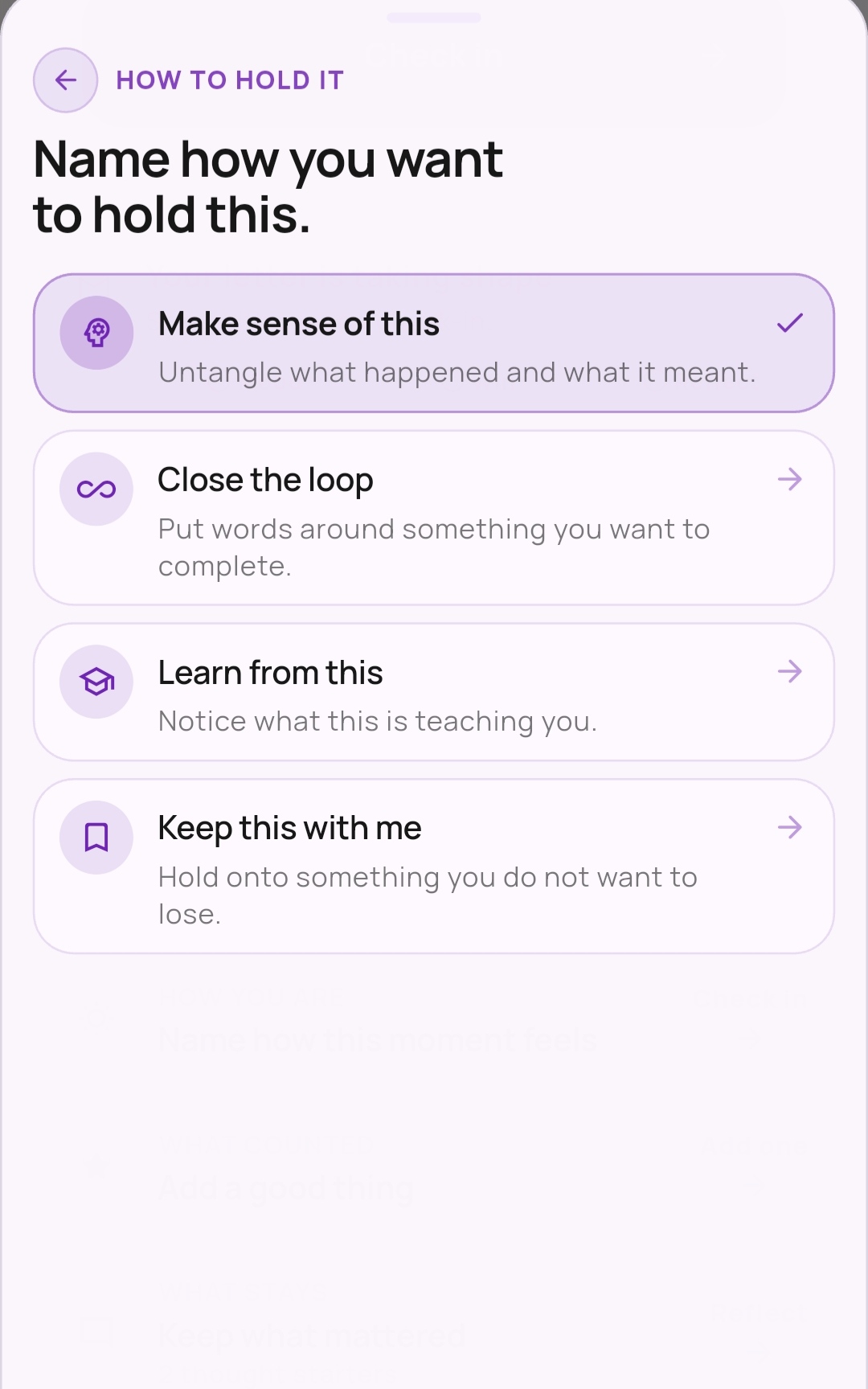
Pick the job of the reflection first:
- Make sense of this when you’re untangling
- Close the loop when something needs completion
- Learn from this when you want the lesson
- Keep this with me when you want to preserve something meaningful
Mode selection prevents rambling and helps your brain know what “done” looks like.
It also improves emotional safety. When your mind knows the purpose, it is less likely to spiral into every open loop at once.
Write to a limit, not to exhaustion.
Set a clear boundary: 6-10 sentences, or 8 minutes. Stop when you hit the limit. You are building continuity, not proving depth every day.
This is especially important on high-pressure weeks. Consistent short reps build trust faster than occasional long entries followed by long silence.
Use this structure:
- What happened
- What it brought up
- What you need next
That’s enough for signal capture.
Let the prompt source guide your focus.
KeikoAI prompts are not generic; they come from your data: mood pattern shifts, significant moments, previous reflections, or your own initiative. If a prompt points to a recurring tension, answer that tension directly rather than retelling your whole day.
Short reflection + relevant prompt beats long reflection + vague topic every time.
If a prompt feels too big, narrow it with one constraint: “What is one thing this situation is teaching me about my limits, needs, or patterns?”
When a day is too full, free-write two lines and tag the mode anyway. Even minimal entries keep your pattern readable for Reconnect and useful for Guide.
Reflection becomes something you can trust, not dread
After a few weeks, the change is subtle but real. You stop waiting for ideal conditions to think clearly. You create small containers where clarity can happen inside real life.
You also stop confusing volume with insight. Ten grounded lines tied to the right prompt often reveal more than three pages of unstructured spill.
Over time, this gives Reconnect better material to connect across mood and moments. Your reflections stop being isolated entries and become part of a readable arc.
Most importantly, you build evidence that you can meet your inner life without disappearing into it. Reflection becomes a steady practice of returning, not a performance of being profound.
That’s what makes the habit sustainable: it fits your life as it actually is, not some ideal version of it.
Keep reflection light, clear, and consistent
Use KeikoAI Reflection prompts with the right mode and a small writing limit so insight stays practical.
Try KeikoAI freePrivate by design · No streak pressure
Follow us to see what's new