

You walk into a meeting steady and leave carrying everyone’s urgency, frustration, and unfinished tension. By evening you’re depleted, even if your own work was fine. You call it empathy, but it’s starting to cost too much.
When this repeats, your baseline narrows — less patience, less clarity, less room for your own priorities. The day feels full before your real work even starts.
You don’t need to become cold. You need a filter.
Care without boundaries becomes emotional debt
Part of it is just constant exposure to other people’s stress. Part of it is confusion — you genuinely can’t tell what belongs to you and what you picked up from the room. And plenty of workplaces reward this kind of emotional over-functioning and call it professionalism.
What’s actually happening is unfiltered load transfer: your system treats every signal in the room as your responsibility.
Leave that unchecked and you’ll keep doing emotional labor nobody named and almost nobody notices — not because you’re weak, but because nothing in the room is sorting whose feeling belongs to whom.
◆ Boundary truth
Nobody hands you a bill for absorbed stress. You just quietly pay it, evening after evening, until you notice the balance.
Use a three-part boundary loop during your workday
Label the source in real time.
After high-intensity interactions, ask: “Is this mine, theirs, or shared?” Write one line if needed. This stops unconscious merging.
If you can’t classify it, treat it as shared for now and avoid immediate reactive decisions.
That pause protects judgment. Emotional urgency often impersonates strategic urgency.
Run a 3-minute nervous-system reset between blocks.
Short reset before your next task: slower exhale, unclench jaw, feet on floor, one long shoulder drop. If you use KeikoAI, “Steady This” is the right Guide mode when activation is high and thinking quality is low.
The goal is not serenity. The goal is stopping carryover.
Carryover is what makes one hard meeting contaminate the next four hours. A short reset breaks that chain.
Convert one absorbed signal into one boundary action.
Pick one concrete move:
- delay reply until tomorrow,
- ask for clearer ownership,
- move a low-priority task,
- or say no to one additional ask.
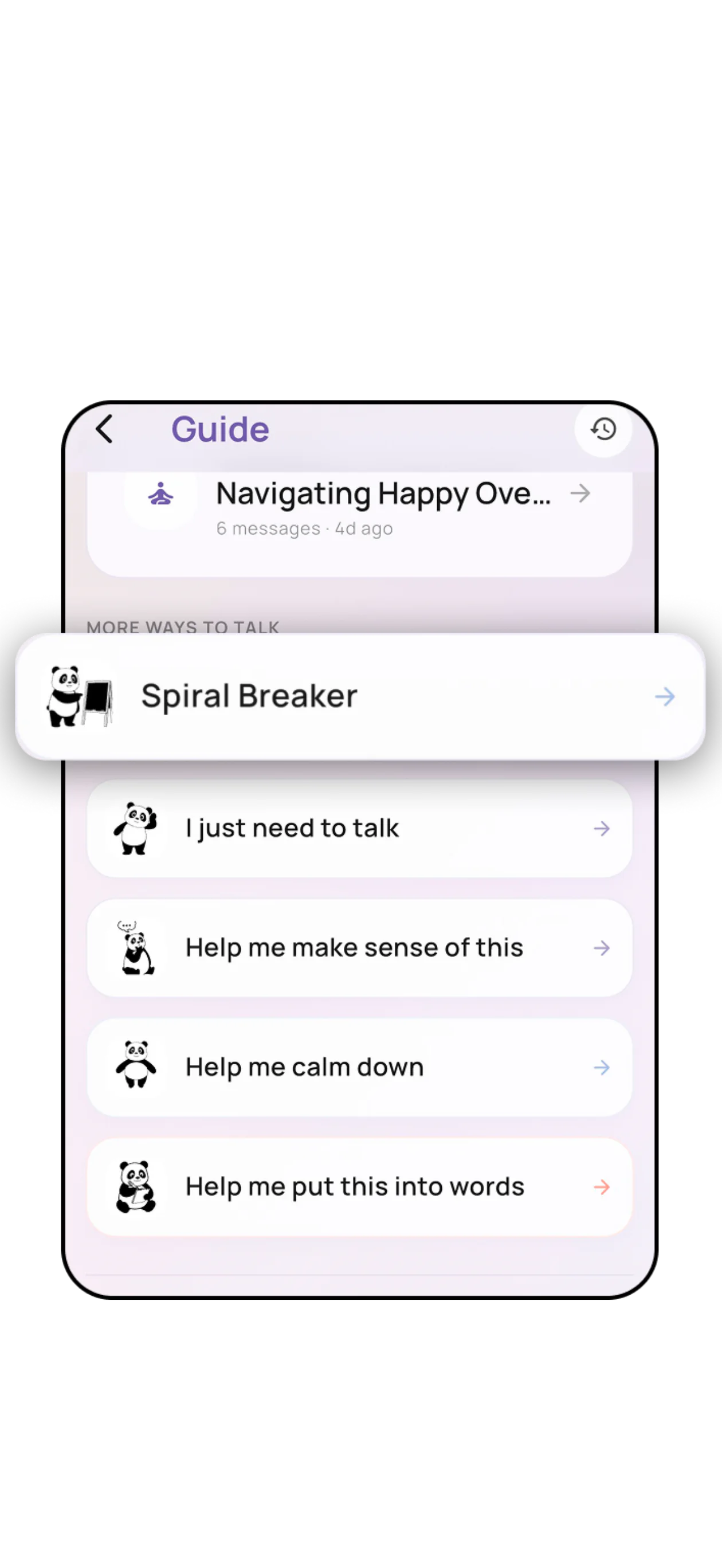
If you use KeikoAI Guide, switch to “Find My Next Step” when you need help translating emotional noise into a practical next step.
You can ask one focused question: “What is one action that protects capacity without avoiding responsibility?” Keep it concrete and time-bound.
This sequence prevents empathy from becoming self-erasure. You still care. You just stop paying every emotional bill in the room.
Over time, your colleagues experience you as calmer and clearer, not colder. Boundaries improve your contribution because your attention is no longer fragmented.
You may also notice fewer end-of-day crashes. The same amount of work feels more manageable when you’re not carrying emotional residue from every interaction.
You stay generous without disappearing
When you practice this consistently, work feels lighter without becoming superficial. You’re still responsive, but not permeable to everything.
Your energy stops leaking through invisible openings. You make better decisions because your state is yours again, not a blended average of everyone around you.
Most importantly, your identity shifts from “the one who holds it all” to “the one who knows what to hold and what to set down.” That is sustainable care.
That identity holds up better than constant availability ever did. It lets you show up consistently instead of running on empty.
Stay empathetic at work without emotional spillover
Use KeikoAI Guide to steady your state, set clearer boundaries, and protect capacity without shutting down.
Try KeikoAI freePrivate by design · No streak pressure
Follow us to see what's new