Why we built Keiko — and why we're writing about it
The journal that never talked back. The 6/10 mood scores that meant nothing. This is what actually pushed us to build this.

Badal
Co-founder
I used to journal. Consistently, even. I’d write a page every morning, feel better for a few days, and then stop. And the thing that got me wasn’t the stopping — it was that the journal never gave anything back. It just sat there. Hundreds of pages of my own thoughts, and I couldn’t tell you a single pattern I’d found from them.
That’s not a discipline problem. That’s a feedback problem.
The others on our team had their own version of the same thing. Ria would track her mood — 6 out of 10, 6 out of 10, 5 out of 10 — and get absolutely nothing from the numbers. Ganesh had questions he couldn’t ask anyone, not his manager, not his friends. He just needed to think clearly with someone who wasn’t going to judge him. Abhishek would get good advice, know it was right, and still not do it — because the advice was never small enough to actually try.
We were all doing some version of self-improvement. None of it was working.
The problem isn’t that people don’t reflect. The problem is that reflection without feedback is just talking to yourself.
What Keiko actually is
Keiko is a journal that talks back.
You log your mood, write about your day, track the small things. The Guide — our AI layer — reads across everything you’ve written over weeks and months. It doesn’t give you generic advice. It finds the specific things that seem to correlate with you feeling better or worse, and it turns those into small experiments you can actually run.
Not “try meditating.” More like: “You’ve mentioned sleep in 80% of your low-mood entries. Want to track sleep for two weeks and see what we find?”
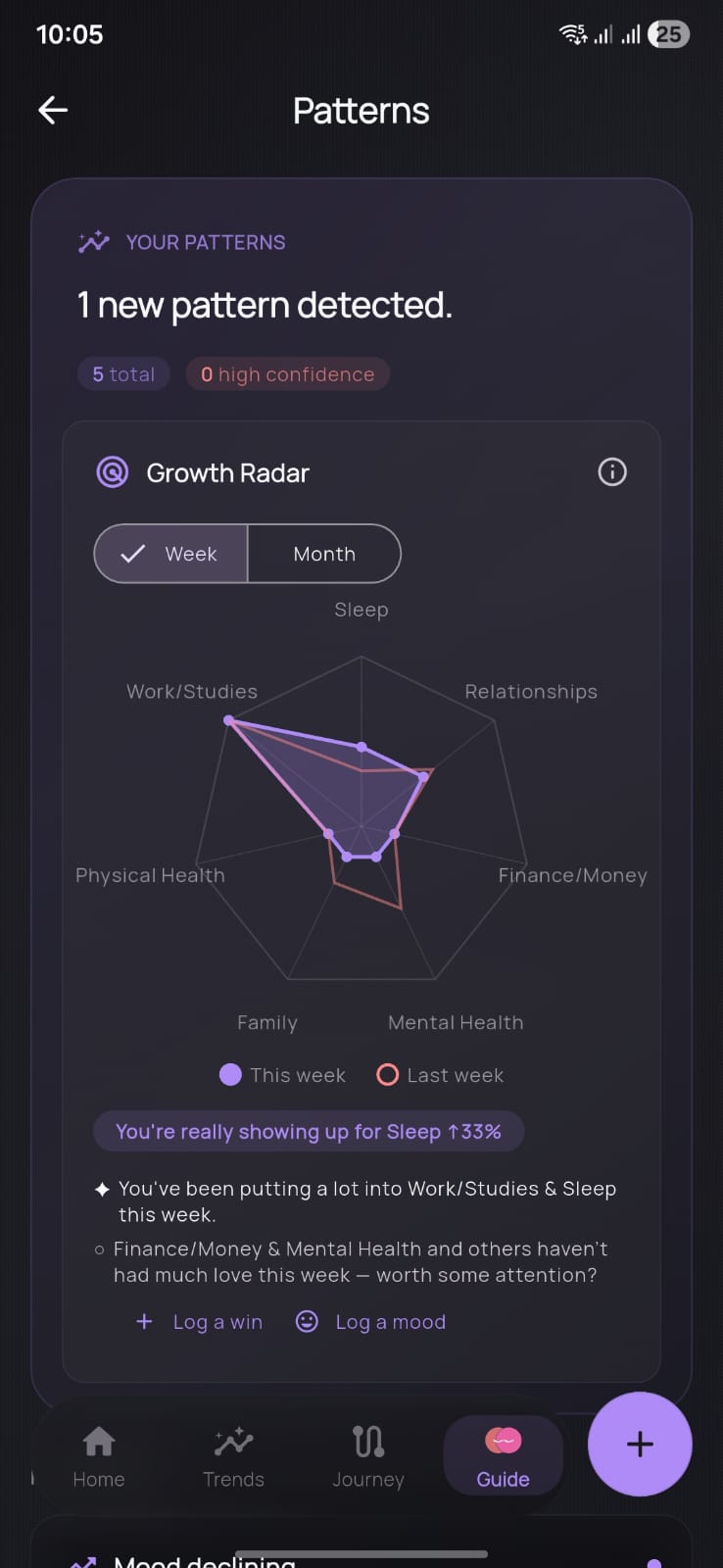
The difference matters. One is advice. The other is a hypothesis you can test.
◆ The thing that surprised us most
When people actually run the experiments Keiko suggests — even small ones — they report feeling more in control within two weeks. Not because the experiments always work, but because they’re doing something specific instead of something vague.
Why we’re writing
We’re building in a space full of noise. Wellness apps, journaling tools, AI companions — most of them lean on the same language: clarity, growth, transformation. It’s hard to tell them apart.
This blog is how we think out loud. We’ll write about the decisions we’re making and why, the research that actually changes how we build, honest updates on what’s working and what isn’t, and practical guides for getting more out of Keiko.
We’ll post when we have something worth saying. Not on a schedule. Some of these will be long. Some will be a paragraph. Both count.